
Faculty of Diagnostic Medicine
Faculty of Diagnostic Medicine unites departments specialized in training doctors in the speciality "Medical Diagnostics", as well as other university departments. The faculty council, which comprises nine departments, is the representative collegial governing body. Dean is responsible for managing activities of the faculty and faculty council.

Educational process is carried out in the university departments by highly qualified university specialists, by means of traditional and innovative teaching methods and modern technologies.


Starting from September 2021, students studying in the speciality "Medical Diagnostics" have been offered the following courses in their fifth year of pre-graduate internship: "Clinical Laboratory Diagnostics" and "Instrumental Diagnostics".


During the first three years, students study social sciences, humanities, and natural sciences, receiving basic training necessary for a doctor. The most thorough study focuses on various areas of chemistry (general, bioorganic, analytical, and biological), medical and biological physics, medical imaging physics, microbiology, histology, normal and pathological physiology. This lays the foundation for skills, abilities, and knowledge.


The senior (4th and 5th) courses combine study of clinical disciplines with training in diagnostic profile disciplines. Students of the Faculty of Diagnostic Medicine study the same clinical disciplines as the students of the medical the Faculty of General Medicine: internal diseases, surgical diseases, obstetrics and gynecology, infectious diseases, etc. In addition, clinical laboratory diagnostics, functional diagnostics, radiation diagnosis and radiation therapy, medical visualization are studied in depth.


According to the Generation 3+ curriculum, students majoring in Diagnostic Medicine complete academic and practical trainings after each year of study. 1st year: academic training "Introductory training", 2nd year: academic training "Medical care and medical instruments," 3rd year: practical training "Nursing and Laboratory", 4th year: practical training "Medical Diagnostic". Students majoring in Medical Diagnostics after successfully completing summer practical training after their 3rd year, are eligible to occupy positions as mid-level medical personnel.


Students are trained in functional, radiation, and ultrasound diagnostics in a step-by-step manner, mastering various components: medical diagnostic equipment, normal anatomy on multiplanar reconstructions, fundamentals of medical imaging, fundamentals of functional diagnostics, functional diagnostics, medical imaging, differential diagnosis in abdominal ultrasound examination, functional tests in cardiology, etc.


During their studies, students acquire practical skills in laboratory and instrumental research methods and choose examination strategies and tactics for patients.
Students acquire practical skills in simulation and assessment center using various modules, including "Diagnostics" module, introduced in 2021. This module includes four diagnostic fields, which enhance the practical component of students in the Faculty of Diagnostic Medicine and enhance their knowledge of the use of imaging methods in diagnosing various diseases of organs and systems.
The module is equipped with the VIMEDIX virtual simulator—the world's only simulator that, on a single platform, provides training in abdominal, pelvic, and thoracic pathologies, including various heart conditions. It also includes a section on obstetrics and gynecology. An animated 3D model can be displayed in real time alongside the ultrasound image.


The faculty's specialized departments have excellent facilities and are equipped with state-of-the-art diagnostic equipment, including expert-grade and high-end ultrasound machines, a portable ultrasound machine, an ECG unit, and etc.
Despite the complexity of education, student years are not limited to study. At the faculty, every student can show their talents in sports clubs, student self-management councils, artistic amateur activities, and participate the social and cultural life of the university and the city, as well as volunteer activities.


Starting from their first year, students of the Faculty of Diagnostic Medicine attend scientific clubs. This work is interesting and engaging. Students are finalists in the competitions "MedicalStartup" and "100 Ideas for Belarus". They actively participate in the Olympiad movement of the Republic of Belarus and the Russian Federation.


By participating in the scientific circle students learn the basics of conducting scientific research, present their findings at scientific and practical conferences and have the opportunity to participate in international conferences.


Studies at the Faculty of Diagnostic Medicine ends with passing of state examinations and solemn delivery of diplomas and certificates of honor for active participation in the life of the university.
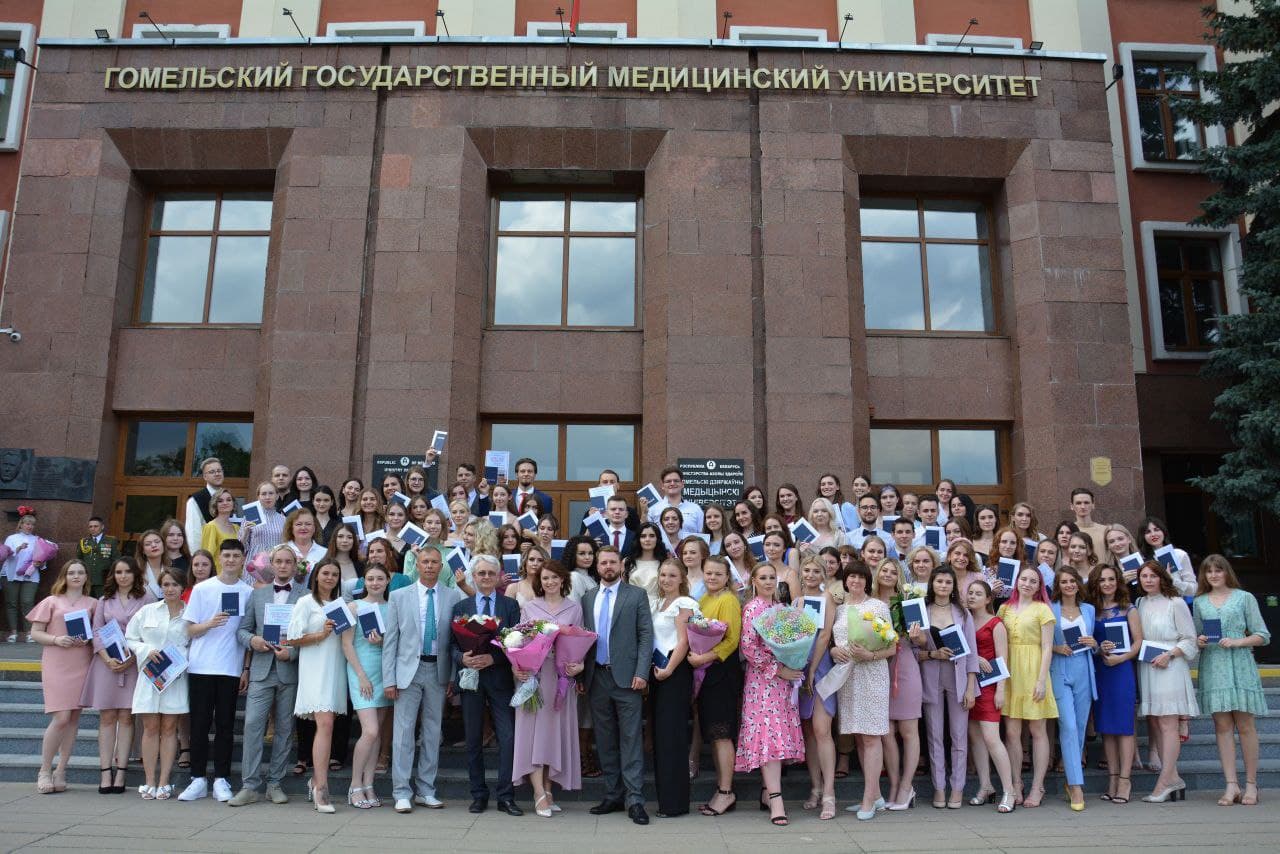
Graduates of the faculty are awarded the qualification of "Doctor" with subsequent employment opportunities in medical diagnostic positions at healthcare institutions. After completing a one-year internship, graduates of the Faculty of Diagnostic Medicine take an exam entitling them to independent work.

Over the past 29 years, the Faculty of Diagnostic Medicine has trained over 1,800 specialists in diagnostic and preventive fields.

